Showing posts with label Essays. Show all posts

Monday, October 26, 2015

Kim (Norton Critical Edition)


Written by Rudyard Kipling, Kim is a rich and complex novel that punishes the lazy and the ignorant (me it seems). Admittedly, it’s the end of semester and I had to read this for uni so my approach to reading it wasn’t of the best shape. But I made it all the way through and I can recognise a complex literary masterwork when I plough through one. Such a book is Kim

Born in India, but of Irish heritage, Kim lives as an urchin of the streets after the separate deaths of his parents. Educated in the ways of the streets, the young Kim craves adventures and to learn new things and sees opportunity when he meets a Tibetan holy man on a pilgrimage. Deciding to accompany the holy man as his ‘chela’, Kim’s heritage catches up with him when he is taken in by the British military and sent to a military boarding school. After three years he is a valuable member of the British Secret Service and as he matures, he becomes torn between his heritage and his dear India. 

I am going to be honest; I could not follow this book at all. But I think that’s because I wasn’t in the best mindset to read it and I wasn’t really taking all of it in: just reading it as words on a page. But what I could glean from it was strong themes of identity, maturity, knowledge, and imperialism. Kipling writes about an Asia that is still lumped together in a generalised way of free indirect speech, but at the same time vibrant and packed to bursting with different creeds, cultures, religions, and characters. It’s a coming-of-age tale that is also a masterful example of world building. 
I found that sometimes it seems as though the story propels itself forward suddenly, it almost feels like you’ve missed a page, but for the larger part you’re carried through smoothly with Kim, taking part in his adventures. 
One thing that I struggled with was the deliberate use of archaic English that Kipling uses in the dialogue. It starkly contrasts with the omniscient narration (in certain places more than others), but you do get used to it. As with all Norton editions, this book features a plethora of background essays and articles as well as footnotes throughout the text itself to help the reader understand and gain more from the story. I personally don’t break up the pace of my reading by jumping down to the bottom of the page to read the explanatory footnotes, so obviously I could have gotten more out of this book. 
Filled with drama, comedy, adventure, growth, and love, Kim is a beautiful tale and a masterfully written work; I could take that away from it. Ultimately through, it wasn’t a book that really appealed to me and I found it quite a challenge to read. 

Tuesday, November 11, 2014

Piers Plowman


An titanic long poem written by William Langland, Piers Plowman is ‘life by the book’ for dummies, a tangible work that could be understood by everyone back in its heyday, preaching through crassness and vibrant dream visions how to live a relatively comfortable and spiritually fulfilling life whilst being surrounded by sin. The Norton Critical Edition features the poem written in Middle English on one page and then a modern translation on the page opposite, which makes it much easier to read and appreciate, let me tell you. 

A dreamer falls asleep many times and has vibrant visions of scenes that teach him the ways of life, God, Christ, and how to live a religious life whilst being so surrounded by sin. Many a vision he sees including a heated debated between Meed and Conscience, a false marriage concocted by Fiend, Antichrist’s rampage, the Christ figure of Piers the Plowman, and a quest to find and learn from Do-Well, Do-Better, and Do-Best. 

Of all the texts I had to read this semester for Medieval Literature, Piers Plowman was one that I actually rather enjoyed, hence my continuing to read it recreationally. With the translation available, the vibrancy of the poem and the language is really apparent and the imagery that Langland manages to create is quite striking, albeit at its most vibrant parts it’s actually quite crass and even vulgar. I think what I really liked about this was that it was sort of a poetic equivalent of a Stanley Kubrick of Peter Greenway film. Ok let me explain my thinking here: if you think about The Cook the Thief, His Wife, and Her Lover and A Clockwork Orange, things that are considered high art or classiness e.g. decadent cuisine and classical music, are used in conjunction with really, really, awful and vulgar characters, thus dishevelling the classiness of it and making it really crass. That’s what this poem did for me. It took the art for of poetry, which I’m not really a fan of anyway, and used it to describe the grossest things like vomiting. I just get a kick out of the flip that some artists do with that. 
As I mentioned before, this thing is epically long; sitting at a length of twenty passuses or chapters. As you can imagine, there are many different scenes and poetic devices crammed into it. Written in the first person register from the point of view of the dreamer, there’re a number of clever little techniques that work to paint the narrative pictures that enthral. We’ve got the characters of all these virtues and human characteristics personified into physical people, we’ve got allegorical metaphors, we’ve got highly descriptive language, and all manner of things in between. I have to admit, it’s a poem that really stands up after the lengthy passing of time that it’s seen and it’s always nice to see when works, particularly works of literature, do that. 
Filled with love, quests, drama, comedy, action, and spiritual enlightenment, Piers Plowman is a captivating work that I really rather enjoyed. 

Friday, October 24, 2014

Global Literary Theory: An Anthology


A collection of quite possibly every significant or celebrated essay and book chapter about popular theories, Richard Lane’s Global Literary Theory: An Anthology serves as a brilliant stepping stone for those readers out there who are fascinated by theories, theories as applied to literature, or just want to broaden their minds as to how they can interpret their understandings of literature. I have to admit that have not read the entire tome (seriously, the thing is huge), I have read a large portion of it for uni and trust a nerdy masochist such as myself to review books I’ve had to read for uni! But, if I don’t let people know about this book, how else will they? 

As the title hints, the book is a collection of essays and book chapters from heaps of different theorists in various fields: some rock star theorists such as Said, Freud, and Barthes, and some not so well known. The book contains seventy-nine chapters, each one the work from a specific theorist and each chapter begins with a little summary from Lane about what the central points of the forthcoming work are, outlining them in a way that then makes the essay or book chapter itself easier to grasp (because some of them can be quite dense: like Derrida for example). The entire anthology itself is actually pretty good because it really does make you think about applying some of these modes of interpretation to your own readings of texts, not just books but other essays, articles, and stuff. The main bulk of the book is divided into core collections: 

Part 1: Formalism and Structuralism; featuring works from Viktor Shklovsky, Vladimir Propp, Francisco Vaz Da Silva, Ferdinand de Saussure, Roman Jakobson, Roland Barthes, and Julia Kristeva. 
Part 2: Deconstruction and Poststructuralism; featuring works from Pal Ahluwalia, Jacques Derrida, Mary Poovey, Tilottama Rajan, A. T. Nuyen, and Julia Kristeva. 
Part 3: Media, Culture and Postmodernism; featuring works from Walter Benjamin, Marshall McLuhan and Quentin Fiore, Tricia Rose, Edward Said, Ravi Sundaram, Jean-Francois Lyotard, Gerald Vizenor, Jean Baudrillard, and Ziauddin Sardar. 
Part 4: Psychoanalysis and Its Critics; featuring works from Sigmund Freud (of course), Jacques Lacan, Shoshana Felman, Judith Butler, Gilles Deleuze and Felix Guattari, annd Slavoj Zizek. 
Part 5: Marxism, Critical Theory and New Historicism; featuring works from Karl Marx, Theodor Adorno and Max Horkheimer, Fredric Jameson, Sue Vice, Walter Benjamin, Catherine Gallagher and Stephen Greenblatt, and Daria Berg. 
Part 6: Race and Ethnicity; featuring works from Frantz Fanon, Henry Louis Gates Jr., Paul Gilroy, George Elliott Clarke, Dara N. Byrne, Rebecca E. Karl, and Pamela Scully. 
Part 7: Postcolonial Studies; featuring works from Gautam Bhadra, Gayatri Chakrovorty Spivak, Edward Said, Homi K. Bhabha, Chinua Achebe, Gina Wisker, and Thomas King. 
Part 8: Gender and Queer Theory; featuring works from Judith Butler, Slavoj Zizek, Michel Foucault, Eve Kosofsky Sedgwick, Chrysanthi Nigianni, and K. L. Walters et. al. 
Part 9: Feminism; featuring works from Luce Irigaray, Helene Cixous and Catherine Clement, Sandra M. Gilbert and Susan D. Gubar, Margaret Homans, Sonia Shah, Gwendolyn Mikell, and Miriam Cooke. 
Part 10: New Textualities; featuring works from Linda and Michael Hutcheon, Sherrill Grace, Patrick Holland and Graham Huggan, Rebecca Raglon and Marian Scholtmeijer, Jacques Derrida, Hent Di Vries, Jens Zimmermann, Slavoj Zizek, Johanna Drucker, Raymond Siemens, and Liu Kang. 
Part 11: Globalization and Global Studies; featuring works from Suman Gupta, Timothy Brennan, Shaobo Xie, Akbar S. Ahmed and Hastings Donnan, and Rebecca L. Walkowitz. 

Filled with more opinions, theories, questions, and knowledge than you can poke a stick at, Global Literary Theory is a great book for anyone who’s interested in how we make meaning from reading literature. And some of the theories are really interesting too! 

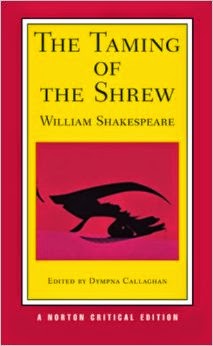
The Taming of the Shrew (Norton Critical Edition)


Shakespeare’s comic play-within-a-play gets taken to new levels of enjoyment (for some) and understanding with the Norton Critical edition. I’ve reviewed a couple of Norton editions before, but I don’t think I’ve expressed how good they actually are, particularly for texts that are written in older forms of English or indeed general craft. Norton Critical editions, for texts that can be challenging to read such as Shakespeare’s or Medieval forms of poetry or whatnot, are pretty valuable for the avid and invested reader because they provide a laundry list of translations, interpretations, and modernisations that really help in not just understanding the central plots of the stories, but gaining further insight into their histories, the influences of the authors, and other stuff. Some of the critical essays, different versions of the stories, and translations are really interesting and they do help to widen the mind and make it think just that little bit more critically, theoretically, and creatively about texts. So brava for Norton! 

Beautiful, pure, and perfect Bianca, daughter of a wealthy merchant, is the centre of much fawning from the men in town. With so many suitors bidding for her, her father arrives at a method by which to determine whom she shall wed. Whoever can find a suitor for her sister, the stubborn, fiery, opinionated, and disagreeable ‘shrew’ Katherina, shall have Bianca’s hand in marriage. Thus one clever suitor persuades the arrogant, stubborn, and cunning Petruchio to ‘tame’ Kate, gain her hand in marriage, and make her the perfect wife. 

Taming of the Shrew is a timeless battle of the sexes that has been revamped and remodelled time and time over. We see remnants of it everywhere in popular culture from the modern version of the 90s, 10 Things I Hate About You to even the Tracey and Hepburn classic Adam’s Rib, not to mention many references to it in David Williamson’s Dead White Males
A comic play-within-a-play, what makes Taming of the Shrew (indeed practically all of Shakespeare’s works) so timeless is the fact that pretty much any type of reading can be applied to it: Feminist, postmodern, Marxist, queer theory, and that is what makes the Norton edition so special because it allows you to think about the play in all these ways, which then bring further meaning to it. Though I have to make the point that I don’t think Shakespeare ever intended for such analysis to be applied to his works, he was popular writer after all and not about literary critical acclaim so much as just writing for the masses. 
Filled with drama, romance, trickery, comedy, and feminist, Marxist, queer, and other such readings, The Taming of the Shrew (Norton Critical Edition) still stands as a classic in the literary canon and when you’re presented with all the other readings, translations, and interpretations in this edition, you can see why. 

Saturday, September 20, 2014

The Book of Margery Kempe


‘Written’ by Margery Kempe, The Book of Margery Kempe is an autobiographical work that proves to be a challenging read for the modern audience. A medieval text (one that I only read because my uni course requited it), this Norton Critical edition takes a little of the challenge out of the read by modernising the language as much as possible, making it much easier to understand than other Medieval texts like, say, Chaucer’s poems (other texts that my course requires me to read). Nevertheless, I found this book really challenging because it’s one big preach fest, written in a disturbingly disjointed kind of way. Having said that, it’s a good book to read for those who aren’t afraid of a literary challenge! 

Margery Kempe, a married woman from Lynn in England, was not one to shy away from sin. That was, until, the Good Lord Jesus Christ came to her in a vision and converted her. Having seen the light, Margery then devotes her life to God and Jesus Christ, preaching their word, going on holy pilgrimages, and saving many people on the way. But with all good there is evil and Margery is not always seen in the best light, receiving much scorn and despite from many people she encounters, including some of holy status. 

It sounds boring right? And, yeah it truly is. For the modern reader, The Book of Margery Kempe is one big preachy/schizophrenic narcissistic indulgence, ripe for all the attack of scepticism and the like that contemporary readers have in spades! My minute fascination that took a long time to germinate, let me tell you, stems from the fact that there is so much controversy about this book even as a literary work. It’s credited as being one of the first autobiographies, but when we consider the 1400s when it was written, can it really fall under that label when we consider that women were more or less illiterate, forbidden to write, and the whole thing was dictated and taken down by male scribes? Is it really autobiography when the woman herself did not physically write it? The ins and outs of that alone are what intrigues me about this book. 
The book itself is preachy, dry, and written in a discordant manner. Divided into two books, each religious escapade, event, or ‘ghostly’ vision is told as a separate chapter and written in the third person register with Margery herself being referred to as ‘this creature’. A few metafictive jibes make their way into the mix, providing a new voice (that of the scribes, for there were two) that delineates away from the monotonous third person omniscient. There’s no real narrative flow either, the whole thing is very jagged and unnerving, a bit like Steven Tyler’s autobiography but nowhere near as interesting! It jumps back and forth between time frames and is quite indicative of its status as dictation: “one time this happened, and then this, and then another time this happened”, that sort of thing. Not very cool really. 
Filled with drama, religious ‘miracles’, love, devotion, and betrayal, The Book of Margery Kempe is a pretty boring and dense read that poses more than one challenge for the contemporary reader. Whilst I didn’t really enjoy it at all, one thing I will say in its defence is that the feeling of achievement that you get when you actually finish reading the entire thing is pretty grand! 

Tuesday, May 14, 2013

Macbeth (Norton Critical Edition)


Well, there’s no point in my saying who wrote Macbeth, or at least who’s most famously credited with writing it. Quite literally everyone in the world knows the works of Shakespeare. I’m now going to be honest and say that I’ve never jumped on the Shakespearean bandwagon. Don’t get me wrong, as a lover of literature, I absolutely love the stories; the romance, the macabre, the mayhem, the drama, and the fantastical but on some strong level of my being, I just have a natural detestation of Shakespeare. 
I’ve come to the conclusion that it’s the hype that’s done this for me. As I said, everybody in the world knows the writings of Shakespeare. This is because anything authored by him has become critical in keeping the world spinning in terms of great literature. I believe that when Shakespeare was writing all these fantastical plays in the 1600s, he didn’t intend to write them so that academics, scholars, and people with too much free time on their hands could write hundreds of pages that read into the symbolism, or the feminism, or the sexism, or the blasphemy, or the political correctness/incorrectness, or whatever. There are quite literally thousands of analysis and analogies of his plays out there in the universe that read more meaning into the actions/existence of characters and pivotal moments of the works than I’m sure Shakespeare intended there to be all those years ago. The end result of all these glowing and raving critiques of his work is now that I don’t want to read them for fear of having my head explode. 
These personal feelings were only peaked by time I finished reading this book for uni. 

Upon emerging victorious from battle Macbeth, Thane of Glamis, encounters three witches that prophesize that he will become Thane of Cawdor and then be hailed as King of Scotland. When the prophecy of Cawdor comes true, Macbeth and his wife plot to bring truth to the second prophecy by murdering the King who fortunately happens to be staying with them. But once on the throne, both Macbeth and his wife slowly slip into madness as they battle and commit tyranny to keep it. 

I think it’s important to note that you can’t read Shakespeare’s works. These are plays and, as such, their power and brilliance is only poignant when you see or hear them. Merely reading them just doesn’t have the same effect. And yes, I am aware of the arguable paradox of that statement, but it’s my rationale and I’m sticking to it! 
Anyway, this particular edition of Macbeth I had to read for uni and, for the Shakespeare enthusiast, it’s actually a pretty good book because it not only incorporates the original play, but several adaptations as well as copious analogies and papers about the play’s characters, symbolism, sexism, etc. We’ve even got arguments from Luther about the existence/non-existence of free will as well as actors’ and actresses’ memoirs on playing the leading roles as well as a closing critique of the various films that have been based on the classic macabre tale of ambition, murder, and madness. We’ve also got some very handy translations jotted throughout the play so that it becomes easier to interpret and understand it as a modern reader, which I quite like because the language of Shakespeare can be very dense and confusing. 
Filled with critiques, murder, betrayal, violence, drama, and madness, Macbeth itself is a wonderful play and the Norton Critical Edition delves deeper into the cracks and crevices of it all. It’s not my cup of tea, but I’d recommend it for any Shakespeare enthusiasts out there or anyone who has an essay on Macbeth due soon and would like some academic works to cite.